Do Service Dogs Have to Wear a Vest in Alabama? Gear, ID Cards and Badges
This page explains the law in general terms. It is not legal advice. For a specific situation, contact the agency listed on this site or an attorney.
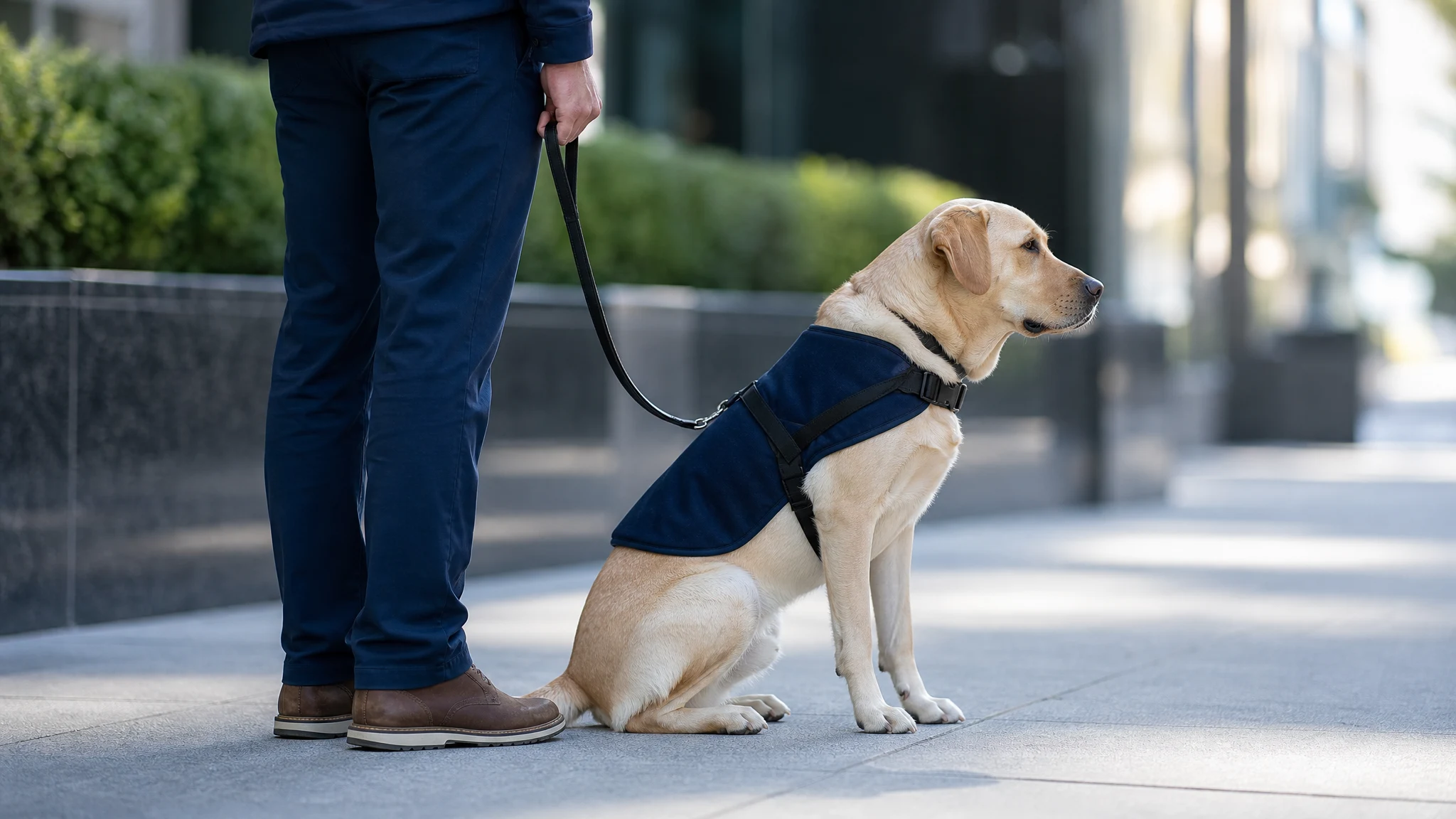
No. A service dog in Alabama does not have to wear a vest, ID tag or special harness. The ADA.gov service animals FAQ says so directly, and Alabama Code 21-7-4 ties access to the dog being under its handler's control, not to gear. The exception is a dog in training, which Alabama requires to carry identification in writing.
Do Service Dogs Have to Wear a Vest in Alabama?
The Americans with Disabilities Act (ADA) defines a service dog by its training, not its gear. The ADA.gov service animals FAQ states: "The ADA does not require service animals to wear a vest, ID tag, or specific harness."
Gear is separate from control. The dog must be harnessed, leashed or tethered in public, unless those devices interfere with its work or the handler's disability prevents their use.
Then the handler must control the dog by voice, signal or another effective means. That is the rule in 28 CFR 36.302(c)(4), and Alabama Code 21-7-4(b) also ties access to leash or tether and control.
Do Dogs in Training Have to Wear a Vest?
For a dog in training, Alabama does require writing. Under 21-7-4(c)(2) and 21-7-6(b)(1), a dog that is a service animal in training must wear a harness, collar, leash, cape or backpack that identifies in writing that it is in training. Under 21-7-6(b)(3), the writing must be legible from at least 20 feet.
The ADA.gov FAQ says that under the ADA "the dog must already be trained before it can be taken into public places," and that some state laws may cover animals in training. The in-training guide covers the Alabama steps.
Some handlers train their own dog for a psychiatric disability, and a course for owner-trainers of psychiatric service dogs can give that work a structure. Whatever route you take, the in-training writing is a state requirement that applies to the dog's gear, not a sign of finished training.
What Does a Vest Prove?
A vest does not by itself prove that a dog is a service dog. Anyone can put a vest on any dog, so the law looks at the dog's training and behavior instead. Alabama's penalty provisions point the same way: 21-7-4(h) makes it a Class C misdemeanor to knowingly and willfully misrepresent the use or training of a service animal.
In housing, 24-8A-5 covers creating or providing a false document, or putting a vest, collar or sign on an animal that is not an assistance or service animal, with the same penalties as misrepresentation. As a practical rule, a vest is a convenience: it can signal to the public that the dog is working, and it does not replace training.
What About ID Cards, Badges and Online Paperwork?
The ADA.gov FAQ says covered entities "may not require documentation, such as proof that the animal has been certified." There is no ADA registry, and the FAQ calls mandatory registration "not permissible under the ADA." No Alabama state ID or registry was found.
For that reason this guide cautions against relying on an ID card, badge or online certificate to establish a right. A card does not by itself prove training, and it conveys no ADA rights. The registration guide covers the paperwork question in full.
Who Can Ask for What?
Different parties may ask for different things. This table summarizes the sources named in each row.
| Who is asking | May ask | May not ask |
|---|---|---|
| Business (28 CFR 36.302(c)(6)) | Whether the dog is required because of a disability, and what task it was trained to do, when the need is not obvious | About the nature or extent of the disability; for certification, training or license documentation |
| Landlord (Ala. Code 21-7-9) | Proof of vaccination compliance (21-7-9(c)(3)) | Extra compensation for the dog (21-7-9(c)(2)) |
| Airline (14 CFR 382.75) | The U.S. Department of Transportation Service Animal Air Transportation Form; a relief attestation on flights of 8 hours or more | Documentation beyond those forms, with limited exceptions for federal, territorial or foreign rules |
Section 21-7-9 says nothing about questions or paperwork for a service animal. Section 24-8A-3 sets a documentation rule, but it is written for assistance animals and is not clearly about service dogs. Check HUD's assistance animals page or ask an attorney.
What Should You Say If Staff Ask for a Vest?
A short answer is enough. If staff ask for a vest or an ID, this is a calm reply:
- Say it plainly. "The ADA does not require a vest or an ID for a service dog."
- Answer the two permitted questions: yes, the dog is required because of a disability, and name the task.
- Stay polite, and do not offer medical details.
If you are refused anyway, the denied entry guide explains the next steps.
Questions
Can a Business Require a Vest?
No. The ADA.gov FAQ says the ADA does not require a vest, ID tag or specific harness, and 28 CFR 36.302(c)(6) bars a business from requiring documentation such as proof of certification.
Is an ID Card a Legal Document?
Not for ADA access. The ADA.gov FAQ says no certification can be required, and registration documents do not by themselves prove a dog's training.
Can Staff Ask Anything Instead?
Yes, the two questions when the need is not obvious. Staff may not ask about the nature or extent of the disability.
Choosing Gear as a Practical Matter
Choose gear for the dog's comfort and the handler's needs. This is reasoning, not a legal rule. A harness that fits, does not rub and does not interfere with the dog's work is more useful than a badge. If the dog shows discomfort or skin irritation, a veterinarian should look at it.
In short, the dog's training and behavior carry the legal weight, and gear is a choice. For the wider picture, see the Alabama service dog laws guide.