Storm Planning for Service Dog Handlers in Alabama: Hurricanes and Tornadoes
This page explains the law in general terms. It is not legal advice. For a specific situation, contact the agency listed on this site or an attorney.
Decide where you will shelter before the weather turns, because a shelter operator in the middle of a storm may not know the rules about service dogs and you will not have time to argue. The short version of the law is that a shelter must generally let your service dog stay with you. The short version of the plan is below.
Pick the Threat That Applies to You
Alabama handlers face two different problems, and they need different plans.
- Tornado warning. You have minutes, not days. The National Weather Service says that at home you should go to a basement, safe room or interior room away from windows, and "don't forget pets if time allows" (National Weather Service, what to do during a tornado).
- Hurricane or tropical storm. You have days of warning, and the decision is whether to leave. Hurricane season runs from June 1 to November 30.
A vehicle is not safe in a tornado, and neither is a mobile home or a tent. Tornadoes can happen at any time of day or night and at any time of year (National Weather Service, tornado safety).
Storm surge has historically been the leading cause of hurricane-related deaths in the United States, and flooding from heavy rain is the second leading cause of deaths from landfalling storms. That flooding can reach hundreds of miles inland (National Weather Service, hurricane safety). A tropical storm that crosses the coast can reach well beyond the Gulf counties, so being far from the water is not a reason to skip the plan.
Where to Shelter With a Service Dog in Alabama
Settle this in advance, and have a second choice.
- A sturdy building you can reach in minutes. If you live in a mobile home, the National Weather Service says it is not safe in a tornado, so the plan has to name a building you can get to, and how long it takes with your dog. Practice the walk once.
- A hotel. A hotel may not restrict a guest with a service animal to "pet-friendly" rooms and may not charge a cleaning fee for hair or dander, though it can charge its usual fee for actual damage (ADA.gov FAQ, questions 11 and 12). The dog must be under your control at all times and cannot be left alone in the room (question 29).
- A public shelter. Ready Alabama says that if you are asked to evacuate in Alabama, you can call 211 to find which shelter will allow you and your pet, and that not all evacuee shelters allow pets (Ready Alabama, Ready Pets). That advice is about pets. Your service dog is not a pet under the ADA.
Service Animal Rules in Alabama Emergency Shelters
The Department of Justice's ADA guidance for emergency shelters says shelters must generally modify "no pets" policies to allow people with disabilities to be accompanied by their service animals, and that a service animal is not a pet (ADA.gov, The ADA and Emergency Shelters).
Its emergency management chapter tells emergency planners that people with disabilities should not be separated from their service animals, even in places where pets are typically not allowed (ADA.gov, Best Practices Tool Kit, emergency management).
Staff may ask only the same two questions as anywhere else, and may not ask for certification, identification cards, a license, special equipment or proof of professional training. The registration guide explains why no certificate is needed. Service animals may also not be kept out of communal food preparation areas in shelters (ADA.gov service animals FAQ, question 10).
Two limits are worth planning around. The handler is responsible for feeding, toileting and care; a shelter has no duty to supervise your dog (ADA.gov FAQ, question 9). And a dog that is out of control, and whose handler does not take effective action, can be removed (question 28). A frightened dog in a loud room is a setting where that can happen.
Pack the Dog's Bag
Ready Alabama's pet kit list is a good base: food, water, medication, veterinary records, a first aid kit, a leash or harness, and a secure carrier, with an ID tag attached to a securely fastened collar and a current photo of your pet.
It also suggests considering a microchip, which can help if you are separated, and a buddy system with a friend or neighbor (Ready Alabama, Ready Pets).
Alabama also runs a free alert system you can register for through the Alabama Emergency Management Agency (Alabama EMA).
Our additions are reasoning, not rules:
- Pack at least a few days of the food your dog already eats, because a change of diet in a stressful week upsets stomachs;
- Keep a short note of the tasks your dog performs, so you can answer the second question quickly;
- Keep the rabies certificate with the vaccination records, since a hotel or shelter may ask what is current;
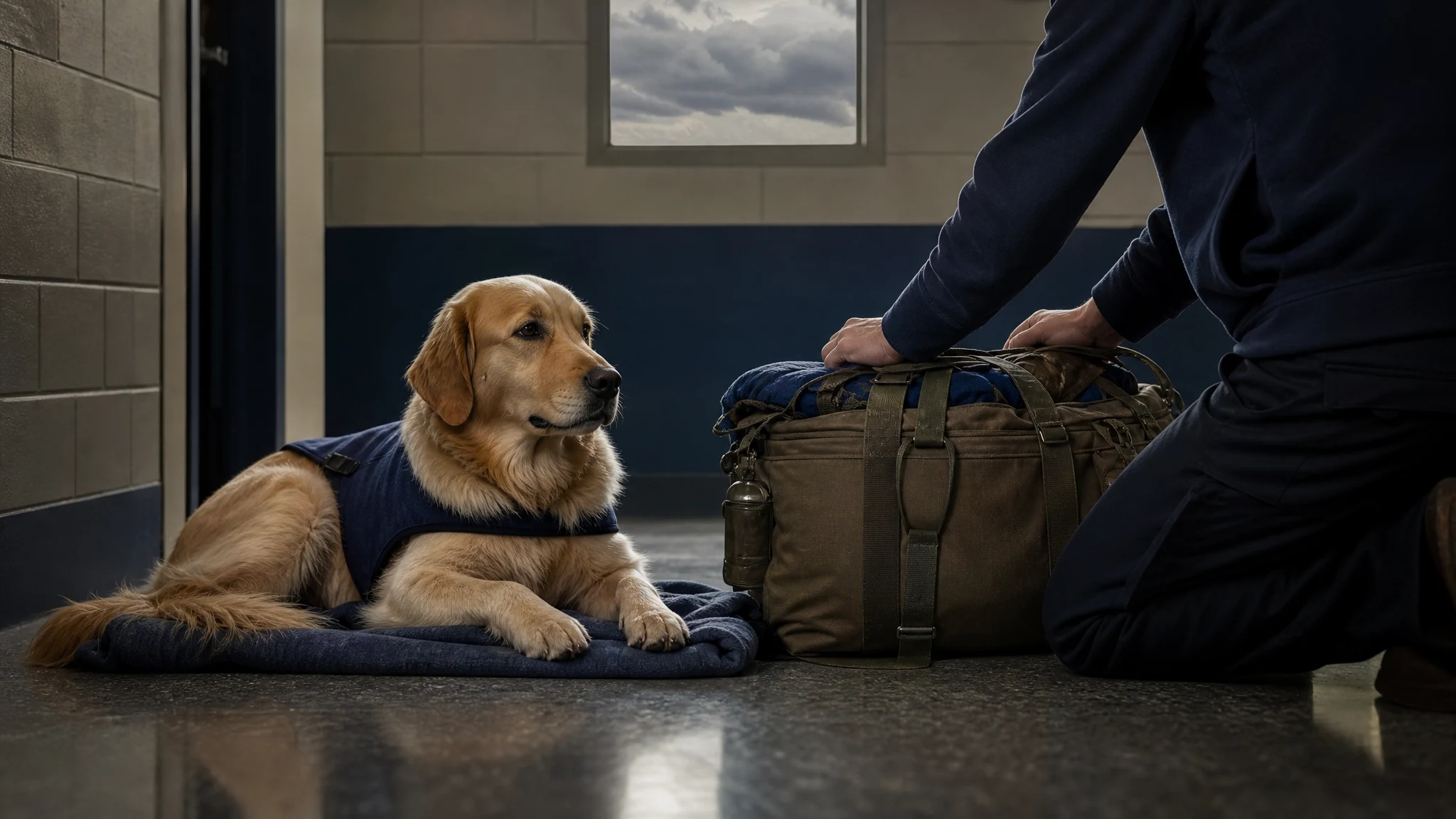
- Pack a bed or mat your dog already knows, because a familiar settling place is the cheapest way to keep a dog calm in a strange room.
Practice the Part That Fails First
A service dog that works well in a store may still struggle in a hallway full of cots and loud weather. The public access skills are the ones to rehearse: settling on a mat in an unfamiliar room, staying calm around other dogs, strangers and noise, and walking at heel through a crowd (see the public access test guide).
If you are training your own dog, add "settle in a strange place for hours" to the plan in the owner-training guide.
If your dog is trained for a psychiatric disability, a psychiatric service dog training course can help you build that calm, steady behavior before storm season.
During and After
- Keep the leash on and the dog close. A frightened dog may bolt through a door during a warning.
- Listen for the warning, not just the watch. The National Weather Service tells people to keep listening to local news or a NOAA Weather Radio for tornado watches and warnings.
- After the storm: Check your dog's paws and gear for debris before you walk, and expect changed streets and smells; go slowly on the first outings.
- If someone at a shelter or hotel refuses your dog: Answer the two questions calmly, ask for a manager, and follow the steps on the denied entry page.
This page is planning information and not emergency instructions. In an actual warning or evacuation order, follow local emergency officials. Some of the steps above are our reasoning from the sources and are labeled as such; a veterinarian can tell you what your own dog needs during a stressful week.
Sources
- National Weather Service, what to do during a tornado
- National Weather Service, tornado safety
- National Weather Service, hurricane safety tips and resources
- Ready Alabama, Ready Pets
- Alabama Emergency Management Agency
- ADA.gov, The ADA and Emergency Shelters: Access for All in Emergencies and Disasters
- ADA.gov, ADA Best Practices Tool Kit for State and Local Governments, Chapter 7, emergency management
- ADA.gov, Frequently Asked Questions about Service Animals and the ADA