Miniature Service Horses in Alabama: Why the State Definition Includes Them
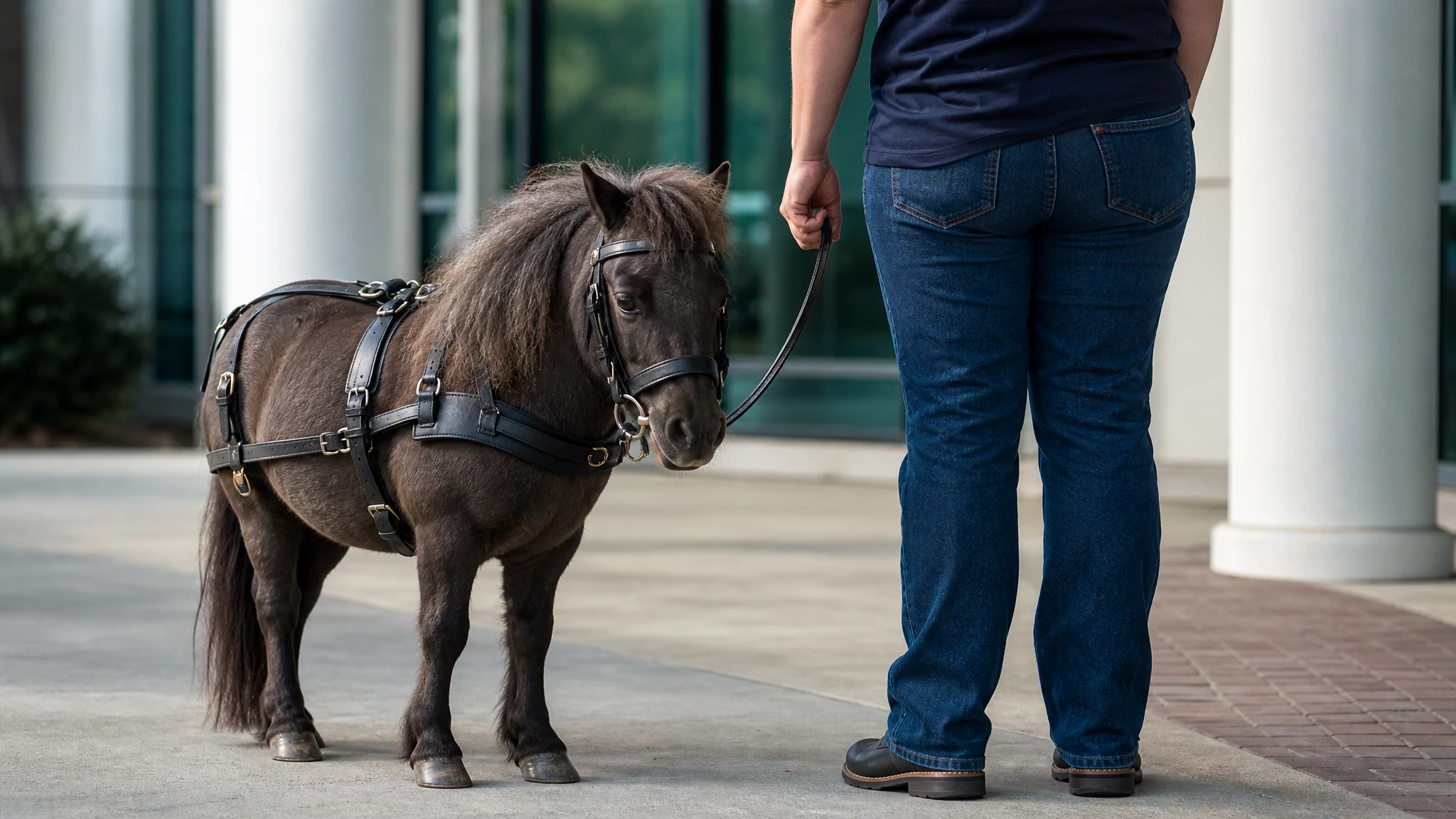
This page explains the law in general terms. It is not legal advice. For a specific situation, contact the agency listed on this site or an attorney.
Alabama law limits the term service animal to a dog or a miniature horse for sections 21-7-3 to 21-7-5 of the Code. The Americans with Disabilities Act (ADA) defines a service animal as a dog only, then covers miniature horses in a separate rule, 28 CFR 36.302(c)(9). This site's guides are about dogs.
What Does Alabama Law Say About Miniature Horses?
The Alabama Code defines a service animal in section 21-7-1. For sections 21-7-3, 21-7-4 and 21-7-5, the term is limited to a dog or a miniature horse. That is the reason a miniature horse appears in the state's access rules, and the reason this page exists.
The same definition says a service animal is an animal trained to do work or perform tasks for an individual with a disability. Emotional support or companionship alone is not work or tasks, and a service animal may not be a pet (21-7-1(b)(7)).
This guide's source for the Alabama text is the Animal Legal & Historical Center's Alabama page, a secondary compilation. The official Code was not reachable when this was checked, so read the section itself before you rely on a detail.
How Does the ADA Treat a Miniature Horse?
Under 28 CFR 36.104, a service animal means any dog that is individually trained to do work or perform tasks for the benefit of an individual with a disability. Other species, wild or domestic, trained or untrained, are not service animals for that definition.
Horses get their own rule. Under 28 CFR 36.302(c)(9), a public accommodation must make reasonable modifications to permit the use of a miniature horse that has been individually trained to do work or perform tasks for the individual with a disability.
So the ADA does not call a horse a service animal, but it requires businesses to consider one. The two rules differ in one important way, covered next.
What Are the Four Assessment Factors?
For a dog, the ADA's exceptions are narrow: the dog is out of control, or it is not housebroken. For a horse, the regulation asks the business to weigh four factors when deciding whether it can modify its policies for a specific facility.
- Type, size and weight. Whether the facility can accommodate the miniature horse's type, size and weight.
- Control. Whether the handler has sufficient control of the miniature horse.
- Housebreaking. Whether the miniature horse is housebroken.
- Safety. Whether the horse's presence in a specific facility compromises legitimate safety requirements that are necessary for safe operation.
The first and fourth factors have no counterpart in the rule for dogs. They make the answer depend on the facility, which is why one building may admit a horse and another may not.
Miniature Service Horse in Alabama: Dog and Horse Rules Side by Side
| Question | Dog | Miniature horse |
|---|---|---|
| ADA definition (28 CFR 36.104) | Yes, if individually trained to do work or tasks | Not a service animal by definition |
| Separate ADA rule | Not needed | 28 CFR 36.302(c)(9), with four factors |
| Alabama 21-7-1 for 21-7-3 to 21-7-5 | Included | Included |
| Air travel (14 CFR 382.3) | Dog only | Not a service animal |
The table leaves out housing. Alabama's housing provisions are covered on this site's housing guide, and they are written around service and assistance animals generally, so ask the housing provider and HUD about a horse before you assume anything.
What Stays the Same for a Horse?
The regulation says sections 36.302(c)(3) through (c)(8), which apply to service animals, also apply to miniature horses. Several familiar rules therefore carry over.
- Two questions. A business may ask whether the animal is required because of a disability and what work or task it has been trained to perform, and may not require documentation.
- No surcharge. A business may not charge a surcharge, though it may charge for damage if it normally charges others.
- Control. The animal must be under the handler's control, with a harness, leash or other tether unless one of the stated exceptions applies.
- Access. The handler may go where members of the public are allowed to go.
The rules on removing an animal in paragraph (c)(2) are not in that list. The regulation's four factors do the screening work for a horse instead. Whether a particular removal was lawful is a question for an attorney.
Why Are This Site's Guides About Dogs?
Dogs are the only animal the ADA defines as a service animal, and dogs are the subject of this site. A horse brings its own questions about size, housing and facilities that a dog guide cannot answer.
If you handle a miniature horse, the sources below are the starting point. Read how Alabama's state rules and the federal regulation each apply, because a state definition that includes a horse does not by itself prove the ADA treats the horse as a service animal.
For the dog side of Alabama law, start with Alabama service dog laws: what state law adds to the ADA. The registration guide explains why no registry or certificate is required for a dog or, under the same ADA rule, a horse.
Who Decides a Specific Case?
An attorney decides what a statute means for your facts. The Department of Justice takes ADA complaints through the ADA complaint page. Housing complaints go to HUD, not the Department of Justice. No Alabama state agency was confirmed for public-accommodation complaints.
The assessment factors are a judgment about one facility and one horse. Expect that a business and a handler may reach different readings, and keep a record of what was said. The denied entry guide shows how to document a refusal, and its steps apply to a dog.
A person who is also training a dog for a psychiatric disability will find the dog rules in the guides above. For that work, psychiatric service dog task training is one place to learn what the tasks involve.