Service Dog Tasks and the Public Access Test, Explained
This page explains the law in general terms. It is not legal advice. For a specific situation, contact the agency listed on this site or an attorney.
Two ideas come up again and again when people plan to train a service dog: the tasks the dog performs, and the public access test. They are related, but they are not the same thing. Tasks are what make a dog a service dog.
The public access test is a way to check that the dog behaves well in public.
This guide walks through both in order. You will see what counts as a task, how to build one, how to practice public manners, and how to use a public access test as a training benchmark. It also covers what Alabama and federal law say. For the full owner-training plan, see the step-by-step guide.
The Short Answer
ADA.gov defines a service animal as a dog that has been individually trained to do work or perform tasks for a person with a disability. The tasks must relate directly to the person's disability. That is the whole federal test for what makes a dog a service dog.
The public access test is different. It is a training benchmark, and Assistance Dogs International (ADI) is the group most often tied to it. The ADA does not require a dog to pass any such test. Think of it as a useful way to find gaps in your dog's training, not a legal gate.
What Tasks Can a Service Dog Do?
A task is a specific, trained action that helps with a limitation caused by a disability. The key words in the ADA.gov definition are "individually trained" and "directly related to the person's disability."
So the question to ask is simple: what does my dog do, on purpose and on cue or in response to a trigger, that eases a disability-related need? If you can name the action and the need it addresses, you are describing a task.
Examples of Tasks by Type of Disability
These are common illustrations, not a complete or official list. Each person's tasks depend on their own needs.
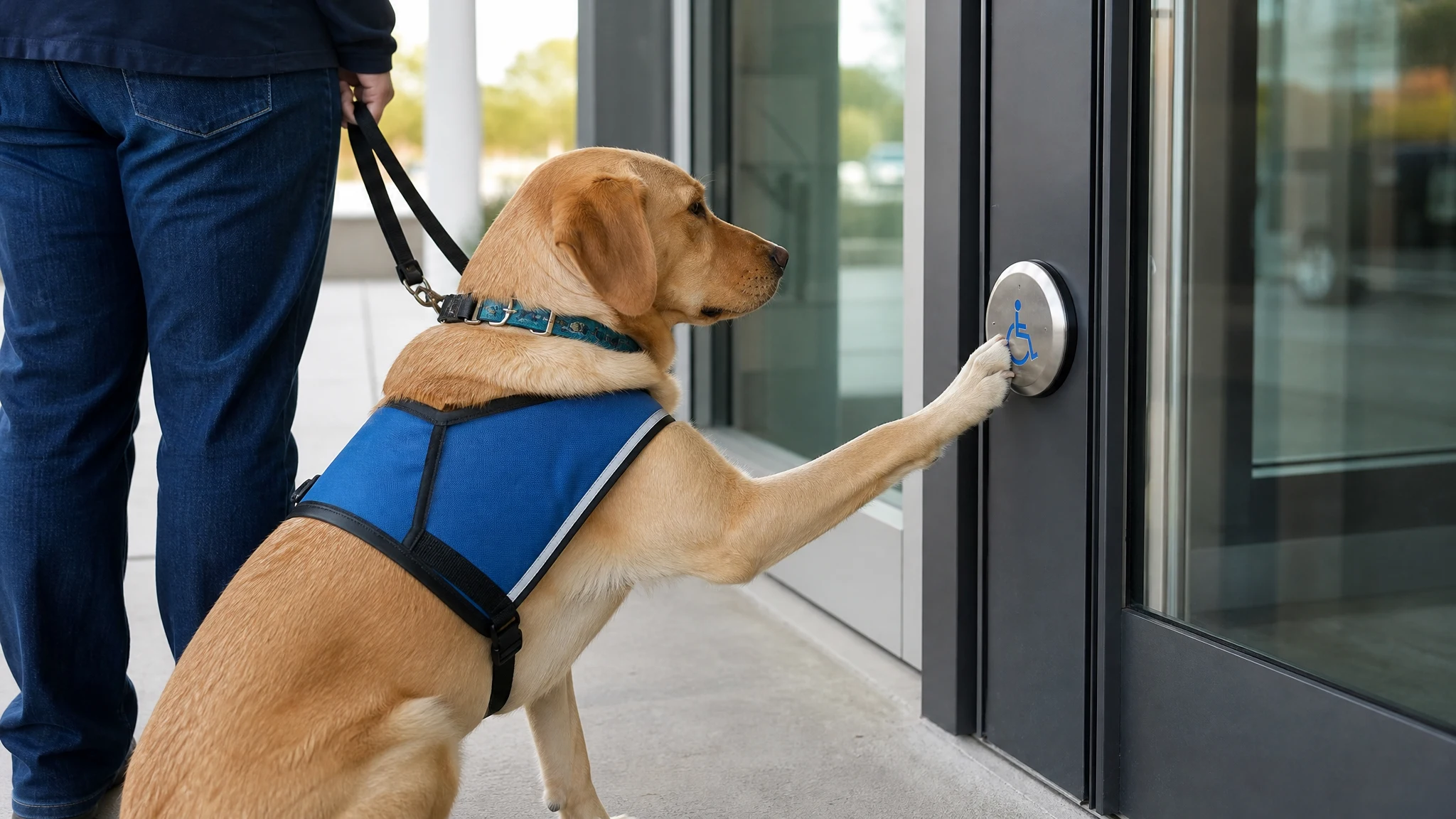
- Mobility disabilities: Retrieving dropped items, opening or closing doors fitted with pull straps, bracing for support while standing, or pulling a light object on request.
- Hearing disabilities: Alerting the handler to a doorbell, a smoke alarm, or a name being called, and leading the handler to the source.
- Medical conditions: Alerting to a change before a medical event, fetching medication, or getting help. Seizure response and medical alert work are listed among the areas that service dogs are trained for.
- Psychiatric conditions such as PTSD: Interrupting a repetitive behavior, turning on lights in a dark room, or creating space in a crowd on cue.
- Autism: Interrupting a harmful repetitive behavior, or staying with and tethering to a child to reduce the risk of bolting, as set up with the family.
- Vision disabilities: Guiding around obstacles and stopping at curbs and steps.
If you are wondering what tasks a service dog can do, the honest answer is that there is no fixed menu. Any trained action that directly addresses a disability-related need can be a task, as long as the dog can do it reliably.
Why Comfort Alone Is Not a Task
Many people love their dogs and find them calming. That bond matters, but it is not what the law means by a task. Alabama's definition, in Ala. Code 21-7-1(b)(7), says a service animal is an animal trained to do work or perform tasks for an individual with a disability.
It adds that emotional support or companionship alone is not work or tasks, and that a service animal may not be a pet.
Federal law draws the same line. Emotional support, therapy and comfort animals are not service animals under the ADA. A dog that simply being present helps with anxiety is not performing a trained task.
A dog trained to press on the handler's legs on cue during a panic episode, or to interrupt a behavior, is doing one. The psychiatric service dog and emotional support animal guide compares the two.
If you want help teaching tasks like these, a training course for psychiatric service dog tasks covers how to build them step by step.
What You Need
- A dog with a steady, friendly temperament and good health. Many dogs are not suited to public work, and that is a normal outcome.
- Small, soft, high-value treats and a treat pouch.
- A clicker or a marker word such as "yes."
- A flat buckle collar or a well-fitted harness, and a standard leash. Use only humane equipment.
- A mat or small bed for settling practice.
- A notebook or phone notes to log each session, the place, the distractions, and what went well.
- A friend or two who can help with distractions.
- A written list of your disability-related needs and the tasks that address each one.
Step-by-Step: From Task List to Public Access Check
Step 1. Write Down the Need Before You Pick the Task
Start with the limitation, not the trick. For example, write "I cannot bend to pick up items" rather than "my dog should fetch." This keeps every task tied to the disability, which is what the ADA.gov definition asks for.
Step 2. Match Each Need to One or Two Realistic Tasks
Choose tasks your dog can physically and mentally manage. A small dog cannot brace for a standing transfer. A dog that is nervous around crowds may struggle with certain tasks in busy settings. Keep the list short at first, since a few reliable tasks are better than many shaky ones.
Step 3. Teach Each Task With Rewards
Break the task into small pieces. Mark the right behavior with a click or word, then give a treat. Build one piece at a time, such as touching the strap, then pulling it, then pulling until the door opens.
This reward-based approach matches the position of the American Veterinary Society of Animal Behavior (AVSAB), which advises against punishment-based methods. Never use shock, prong or choke collars, alpha rolls, scruffing or any dominance method. They can harm a dog and damage the trust that task work depends on.
Step 4. Add a Cue and a Context
Once the dog understands the action, attach a cue word or a trigger. For alert tasks, the trigger is the event itself, such as a smoke alarm sound. Practice in your home first, then in other rooms, then with mild distractions. Fade treats gradually, but keep rewarding often.
Step 5. Build Everyday Public Manners
Tasks only help if the dog can work calmly around people. Teach and proof these basics:
- Walking beside you on a loose leash without pulling or sniffing items.
- Sit, down and stay, including a long down under a table or chair.
- A reliable recall and a "leave it" for dropped food.
- Ignoring other dogs, strangers who talk to the dog, and people who offer food.
- Entering and exiting doorways and vehicles calmly.
- Staying settled while you shop, wait in line or sit through an appointment.
Step 6. Practice in Gradually Harder Places
Move from a quiet driveway to a park path, a pet-friendly store, and then busier indoor locations where you have the right to be with your dog. Keep sessions short. End on a win. If your dog shows stress, such as panting, lip licking, a tucked tail or refusing food, go back to an easier setting.
Do not enter places where animals are not allowed without a clear legal basis. If you are unsure, read the section on Alabama law below. For a dog still in training, the in-training guide explains the marking rule and where to practice.
Step 7. Run Your Own Public Access Check
This is where the service dog public access test comes in. ADI, the organization that sets standards for assistance dog programs, publishes its own public access test. Its exact items and scoring change over time, so check ADI directly for the current version rather than relying on a summary.
You can still build a practice version of your own that covers the same kinds of skills. Ask a helper to watch and score each item as pass, needs work, or not yet:
- Dog stays calm and controlled while you enter a building.
- Dog walks beside you through narrow aisles and past people without lunging or sniffing goods.
- Dog settles under a table or beside a chair for an extended time.
- Dog ignores dropped food and a nearby person eating.
- Dog stays quiet and does not bark or whine without a reason related to its work.
- Dog stays composed around another dog, a cart, a loud noise or a sudden movement.
- Dog does not toilet indoors and shows no signs of being unwell or distressed.
- Dog performs at least one trained task on cue while in public.
Re-run the check in different places. A dog that passes in a quiet shop may not pass in a crowded one.
Step 8. Prepare for the Two Questions
When the need for the dog is not obvious, ADA.gov says staff may ask two things: is the dog a service animal required because of a disability, and what work or task has the dog been trained to perform.
Alabama's public accommodation law, Ala. Code 21-7-4, allows the same two questions and says staff may not ask about the nature or extent of the disability.
Practice a short, calm answer that names a task. For example: "Yes, she is a service dog. She retrieves dropped items and opens doors." You do not need to show papers or demonstrate the task. If a business pushes back, the denied entry guide covers what to do.
Step 9. Keep Records and Keep Training
Log your sessions and review them each month. Skills fade without practice, and new places bring new challenges. If a task stops being reliable, go back a step and rebuild it with rewards.
The Service Dog Public Access Test Is Not an ADA Requirement
It is worth saying clearly. Under the ADA, a dog does not need to pass a public access test, hold a certificate, or wear a vest to qualify as a service animal. ADA.gov's service animal guidance asks about the dog's training and tasks, not about test scores.
There is also no official service dog registry or required certification under the ADA. A dog does not need to be enrolled or have paperwork to be "legal." Online registrations and ID cards are not legal proof of a dog's status, and no Alabama state ID or registry program turned up in the Alabama law we relied on.
The test still has real value. It gives you a structured way to see whether your dog is ready for public work. It also matters in practice, because a handler must keep the dog under control.
Under Ala. Code 21-7-4, the right to bring a service animal into areas of a public accommodation that the public normally uses applies while the animal is under the handler's control.
Some programs and benefits do use accredited training as a standard.
For example, the U.S. Department of Veterans Affairs does not provide service dogs, but it offers veterinary-care and hardware benefits for one prescribed guide or service dog at a time when the training was done by an organization accredited by Assistance Dogs International or the International Guide Dog Federation.
Alabama Law at a Glance
For a fuller look at Alabama's rules, see our guide to service dog training in Alabama. The Alabama service dog laws guide goes section by section. Here are the points most relevant to tasks and public access.
- Definition. Under Ala. Code 21-7-1, for sections 21-7-3, 21-7-4 and 21-7-5, a service animal is limited to a dog or a miniature horse.
- Equal access. Ala. Code 21-7-2 gives a person with a disability the same right as anyone else to use streets, sidewalks, public buildings and other public places.
- No extra charge. Ala. Code 21-7-4 says no deposit or surcharge may be required as a condition of access.
- Dogs in training. Ala. Code 21-7-4(c) gives the trainer the same access rights as a person with a disability, and the dog must wear written in-training identification legible from 20 feet (21-7-6(b)). The in-training guide covers who counts as a trainer.
- Misrepresentation. Under Ala. Code 21-7-4(h) and (i), knowingly and willfully misrepresenting service animal use or training is a Class C misdemeanor, with 100 hours of community service. A second or later conviction is a Class B misdemeanor.
This is general information, not legal advice. For a complaint under federal law, start with ADA.gov. We could not confirm a specific Alabama state agency that takes public accommodation complaints, so check with the agency or the Alabama attorney general's office before filing anything.
Tips for Better Results
- Train the task in many places. A dog that retrieves at home may not retrieve in a store. Repeat each task in new rooms and settings.
- Reward calm behavior often. Settling is a skill. Pay for it generously, especially early on.
- Watch your dog's stress signals. If your dog seems overwhelmed, shorten the outing. Retiring a dog from public work is a kind and valid choice.
- Plan breaks. Give water, a toileting break, and quiet time during long days. Hurricane and tornado season call for a plan too; see storm planning for service dog handlers.
- Ask about accreditation. If you work with an organization, ask whether it is accredited by Assistance Dogs International and what standard it uses for public access. Fees, waitlists and service areas vary, so contact each one directly.
Common Mistakes to Avoid
- Calling comfort a task. If the only benefit is that the dog's presence soothes you, it is not a task under the ADA or under Alabama law.
- Relying on a registry, ID card or certificate. It adds no legal rights on its own, so it is not a substitute for training.
- Skipping the basics. Fancy tasks do not make up for pulling, barking or sniffing in public.
- Using harsh gear or corrections. Shock, prong and choke collars and dominance methods can raise fear and make behavior worse.
- Rushing public outings. Too much too soon teaches a dog to cope badly. Build up slowly.
- Treating the test as a one-time exam. Skills can slip. Recheck them regularly.
- Misrepresenting a pet or a dog in training. Alabama treats knowing misrepresentation as a crime.