Service Dogs at Work in Alabama: Your Rights and Your Employer's Limits
This page explains the law in general terms. It is not legal advice. For a specific situation, contact the agency listed on this site or an attorney.
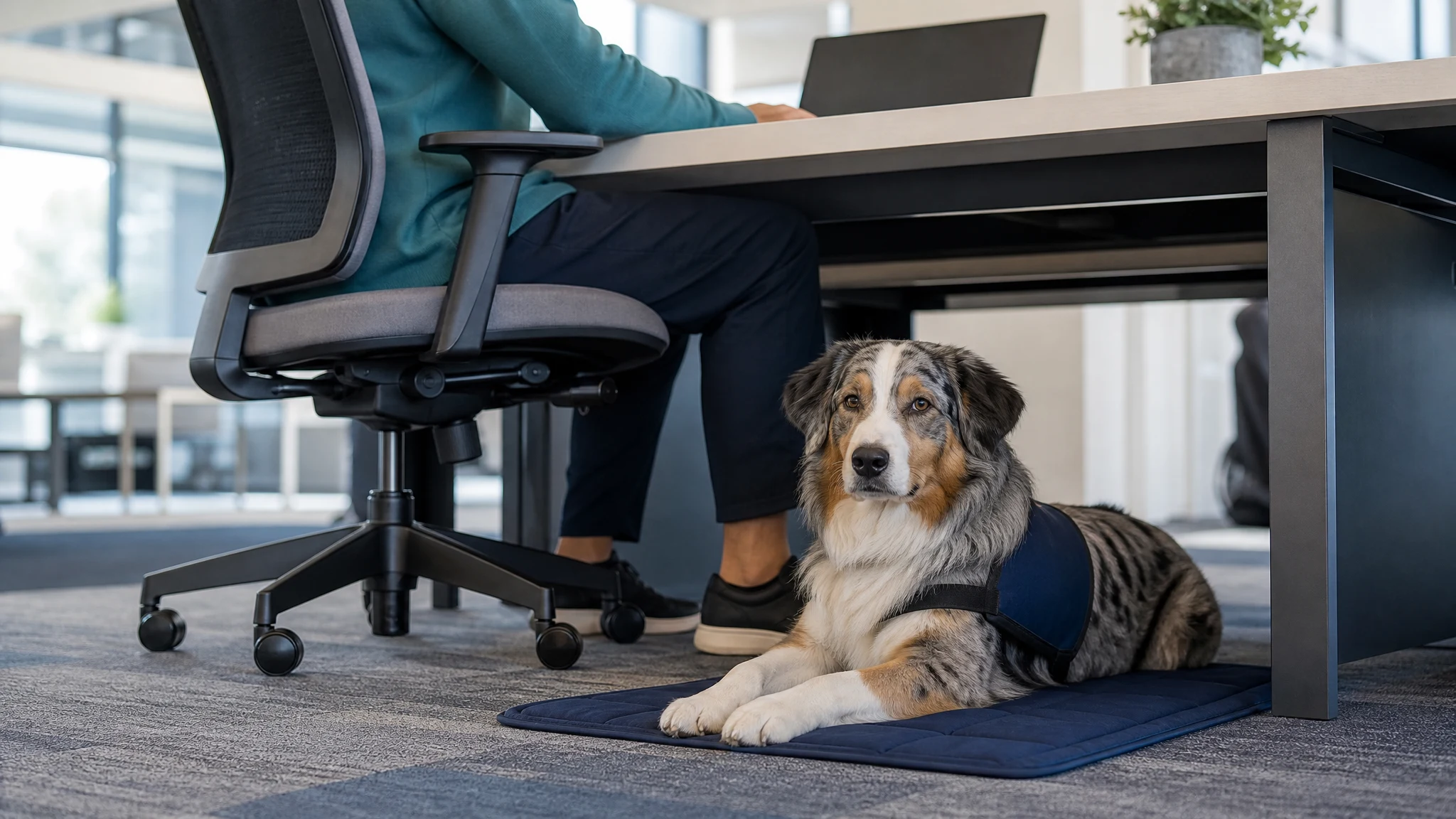
In an Alabama workplace, a service dog is requested as a reasonable accommodation under the Americans with Disabilities Act (ADA), not claimed as a public-access right. The rules for stores and restaurants cover places of public accommodation, not your employer's workplace. At work, you ask, and the two of you work it out.
Why Is Work Different From a Store or Restaurant?
The public-access rule in 28 CFR 36.302(c) covers places of public accommodation, and it lets staff ask two questions about a service dog. Your employer's workplace is not covered by that rule. Employment is governed by a different regulation, 29 CFR 1630 on eCFR.
Under 29 CFR 1630.9(a), it is unlawful for a covered employer not to make a reasonable accommodation to the known physical or mental limitations of an otherwise qualified applicant or employee with a disability, unless it can show an undue hardship on the operation of its business.
So the question is not whether the dog has a right to be there. It is whether the dog is a reasonable accommodation for you.
What Counts as a Reasonable Accommodation?
Under 29 CFR 1630.2(o), a reasonable accommodation includes modifications or adjustments to the work environment, or to the manner in which a job is customarily performed, that enable a qualified person with a disability to perform the essential functions of the job. It also covers adjustments that give equal benefits and privileges of employment.
The regulation's examples include job restructuring, modified schedules, equipment changes and reassignment. A service dog is not named in the parts of the regulation this guide relied on, so treat it as a request that fits the general definition, not as a listed right.
What Is the Interactive Process?
Section 1630.2(o)(3) says it may be necessary for the employer to start an informal, interactive process with the person. The process should identify the precise limitations resulting from the disability and potential accommodations that could overcome those limitations.
In plain terms: you and your employer talk about what the dog does, what limitation it addresses, and how the workday would run with the dog present. Either side may propose a different accommodation.
How to Structure a Request for a Service Dog at Work
This is a structure, not a template. A letter built on it has no legal effect just because it follows this outline, and this guide cannot say what wording is required. Nothing in the parts of 29 CFR 1630 relied on here prescribes wording or form.
As this guide's suggestion, a request usually has these parts:
- Who is asking. Your name, role and the date.
- What you are asking for. That your service dog be allowed at work as a reasonable accommodation.
- The tasks. The work or tasks the dog performs, such as retrieving items or alerting, in terms of what the dog does, not a diagnosis. The ADA.gov service animals FAQ requires tasks directly related to the disability.
- The workday. Where the dog will be, how it will be controlled, and who cares for it.
- An invitation to talk. A request to discuss it with the employer.
- A copy kept. Keep your own record of what you sent and when.
What an employer may require as proof, such as a medical note, is not something this guide could source. Ask an employment attorney before you hand over anything medical.
If the dog is still being trained for a psychiatric disability, for example through a structured online course in psychiatric service dog skills, it may not yet perform reliable tasks. As reasoning, waiting until the dog does the tasks you will describe makes the request clearer.
What Can an Employer Refuse?
The regulation lets an employer decline an accommodation that would impose an undue hardship on the operation of its business (29 CFR 1630.9(a)). This guide cannot tell you what counts as undue hardship for your employer; that depends on the facts, and an employment attorney decides how it applies.
An employer may also propose another accommodation. The same interactive process exists to find one that works.
What About a Coworker With Allergies or a Fear of Dogs?
At a shop or restaurant, Alabama law says allergies and fear of animals are not valid reasons to deny a service dog access (Ala. Code 21-7-4(g)(3)). That rule covers public accommodations. This guide did not find a rule that settles the same question for an employer's workplace.
As reasoning, a coworker's allergy is one more fact for the interactive process, like layout and schedule. The allergies and fear guide covers the public-access side.
What Does Alabama Law Add?
Ala. Code 21-7-8 says an employer may not refuse employment to a person with a disability on the basis of the disability alone. No service-animal-specific employment rule was found. The Alabama service dog laws guide walks through the rest of Chapter 7.
Where to Get Help
For your own case, speak to an employment attorney. For what a service dog does, the tasks and public access test guide lays out how tasks are described. Dogs that are not trained to a task, including emotional support animals, are not service animals under the ADA, according to the ADA.gov FAQ, so describe the tasks, not the comfort.