Proofing a Service Dog Around Food, Other Dogs and Crowds
This page explains the law in general terms. It is not legal advice. For a specific situation, contact the agency listed on this site or an attorney.
Proofing means practicing a skill your service dog already knows until it holds around food, other dogs and crowds. In Alabama, work up a ladder: raise distance, duration and distraction one at a time, reward-based, and drop back a step when the dog struggles. This is a practical method, not a guarantee that any dog will pass.
What Is Proofing, and Why Does It Matter?
A dog that sits calmly in your kitchen has learned a skill in one place. Proofing asks whether it still works somewhere else, with something interesting nearby.
Public access is where it counts. Under the ADA.gov service animals FAQ, a business may ask that a dog be removed if it is out of control and the handler does not take effective action, or if it is not housebroken. A proofed dog is far less likely to reach that point.
The proofing ladder below is this guide's suggestion, built on reasoning rather than a source. It uses reward-based methods only, in line with the American Veterinary Society of Animal Behavior (AVSAB), and nothing in it calls for shock, prong or choke collars, alpha rolls or dominance.
Service Dog Distraction Training: The Proofing Ladder
Change one thing at a time. If you raise the distraction, keep distance and duration easy.
- Start easy. Practice at home with the dog calm and the distraction far away.
- Add distance. Move closer to the distraction in small steps.
- Add duration. Ask the dog to hold the behavior a little longer, then reward.
- Add a distraction. Introduce the next thing only after the first holds.
- Change the place. Take the same exercise to a new setting at the easy level.
- Drop back when needed. If the dog fails twice in a row, return to the last step that worked.
A practical rule for stopping: end the session when the dog cannot eat a treat, cannot respond to its name, or cannot offer a simple known cue. Those are signs the distraction is too much for now.
How Do You Proof a Service Dog Around Food?
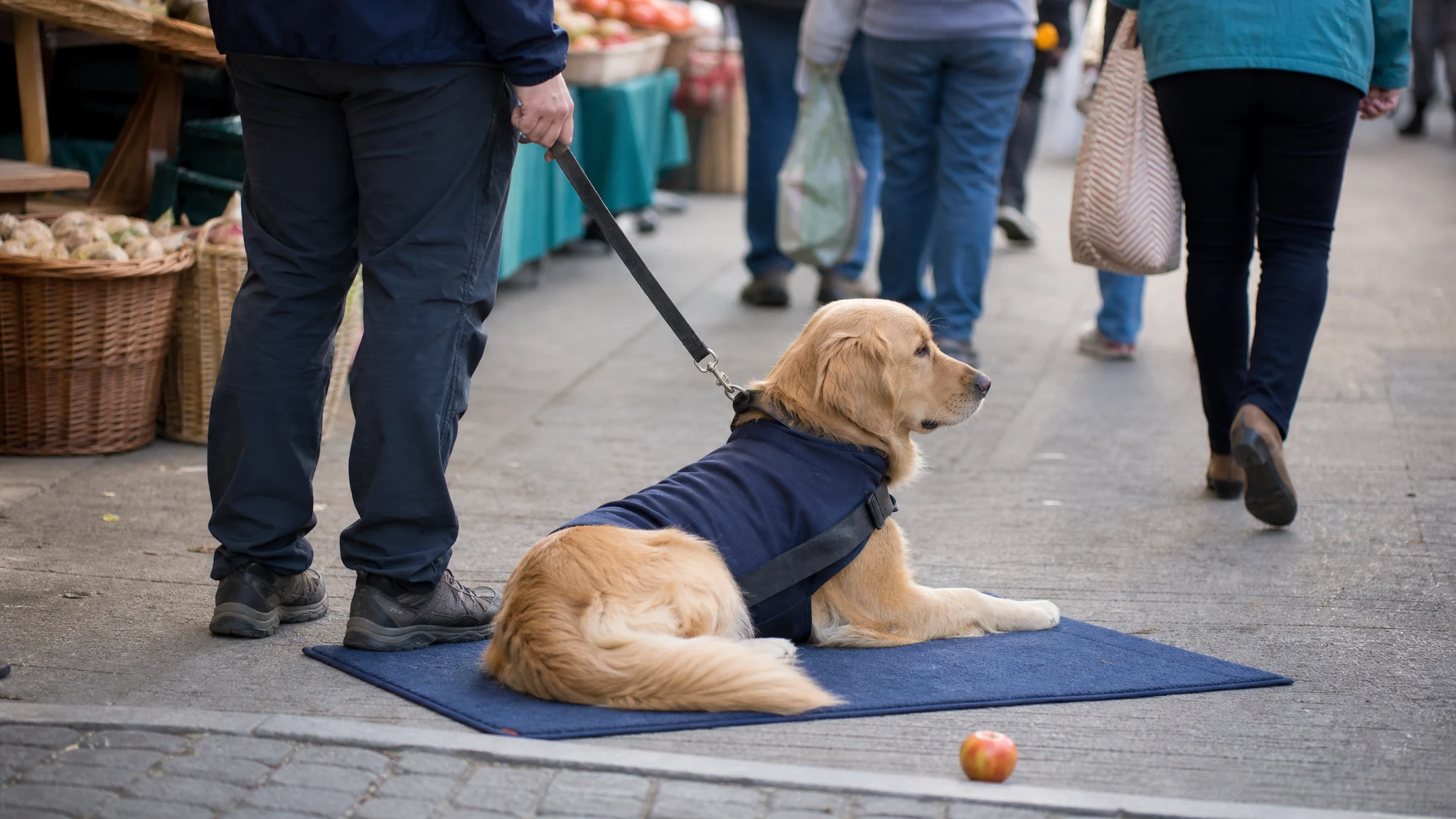
Food is the first distraction because it is everywhere: restaurants, grocery stores, parties. Start with a cue the dog already knows well, such as leave it.
Begin with a low-value item on the floor under your hand, reward the dog for looking at you, and build up slowly. Later, practice with food on a table, a dropped item and a person eating nearby.
On the access side, the ADA.gov service animals FAQ says service animals must be allowed to accompany their handlers to and through self-service food lines. A business is not required to allow an animal to sit or be fed at the table.
That makes a dog's table manners a practical matter. For more on restaurants, see the guide to service dogs in Alabama restaurants and grocery stores.
How Do You Proof a Service Dog Around Other Dogs?
Other dogs are the distraction many handlers expect to meet in public, and many dogs find them the hardest. Begin at a distance where your dog notices the other dog but can still take food and respond to you.
Use these steps:
- Watch from far away. Reward calm attention to you while another dog is visible.
- Close the gap slowly. Move nearer only while the dog stays loose and responsive.
- Practice a walk-past. Pass a calm dog at a safe distance, rewarding focus on you.
- Do not allow greetings. A working dog does not greet strangers' dogs.
If your dog lunges, snarls or tries to attack, stop and see a veterinarian to rule out pain or illness, then a certified behavior professional. For a longer look at how to judge whether a dog is suited, see signs a dog is not suited to be a service dog.
How Do You Proof a Service Dog Around Crowds?
Crowds add noise, movement, touching and smells. Start at the edge of a quiet place and work toward busier ones.
Keep exposures short and end on a success. Keep the dog on a leash or tether. The ADA.gov service animals FAQ says the animal must be harnessed, leashed or tethered in public unless those devices interfere with its work or the person's disability prevents their use, in which case voice, signal or another effective means must keep it in control.
Practice settling beside you while people walk by, then in a line, then in a waiting room. Reward quiet calm and not just attention.
When Is the Dog Ready for Public Places?
Under the ADA, the dog must already be trained before it can be taken into public places, per the ADA.gov service animals FAQ. The same FAQ notes that some state or local laws may cover animals in training.
Alabama's rule for a dog in training includes written in-training identification on its gear, legible from at least 20 feet (21-7-4(c)(2) and 21-7-6(b)). Read service dogs in training in Alabama before you take the dog out.
Proofing is not a test, but it is a good preview of one. See service dog tasks and the public access test explained for what a handler is expected to show.
If the dog is being trained for a psychiatric disability, the tasks need proofing too, and psychiatric service dog classes online can help you plan how each task holds up around distractions.
What If a Dog Cannot Be Proofed?
Some dogs will not get past a certain level, and stopping is a sound decision. A dog that stays stressed, fearful or reactive may be telling you its work is too hard.
Ask a veterinarian about the dog's health first, then a certified behavior professional about behavior. Do not push through with force. The decision to continue belongs to you, informed by those professionals.