Service Dog Commands List: The Cues Every Handler Teaches First
This page explains the law in general terms. It is not legal advice. For a specific situation, contact the agency listed on this site or an attorney.
No Alabama or federal law sets a list of service dog commands. This guide suggests starting with six cues: name, sit, down, leave it, heel and settle, because they support the control that public access depends on. The list is sourced reasoning, not a legal requirement, and it is separate from the tasks that make a dog a service dog.
Which Service Dog Commands Come First?
Think of a cue as a signal the dog has learned to answer, and a task as work directly related to the handler's disability. Under 28 CFR 36.104, a service animal is a dog individually trained to do work or perform tasks for a person with a disability, and the work must be directly related to the disability.
A sit is basic obedience. It does not by itself answer the second question staff may ask, which is about the task. Cues give you control; tasks are what the law looks for.
The First Six Cues in Order
These are this guide's suggestions. Every method here is reward-based, in line with the American Veterinary Society of Animal Behavior (AVSAB) position that reward-based training is the approach to use. No shock, prong or choke collars, alpha rolls or dominance.
- Name. Say the dog's name, then reward the moment it looks at you. This builds attention, which every other cue depends on.
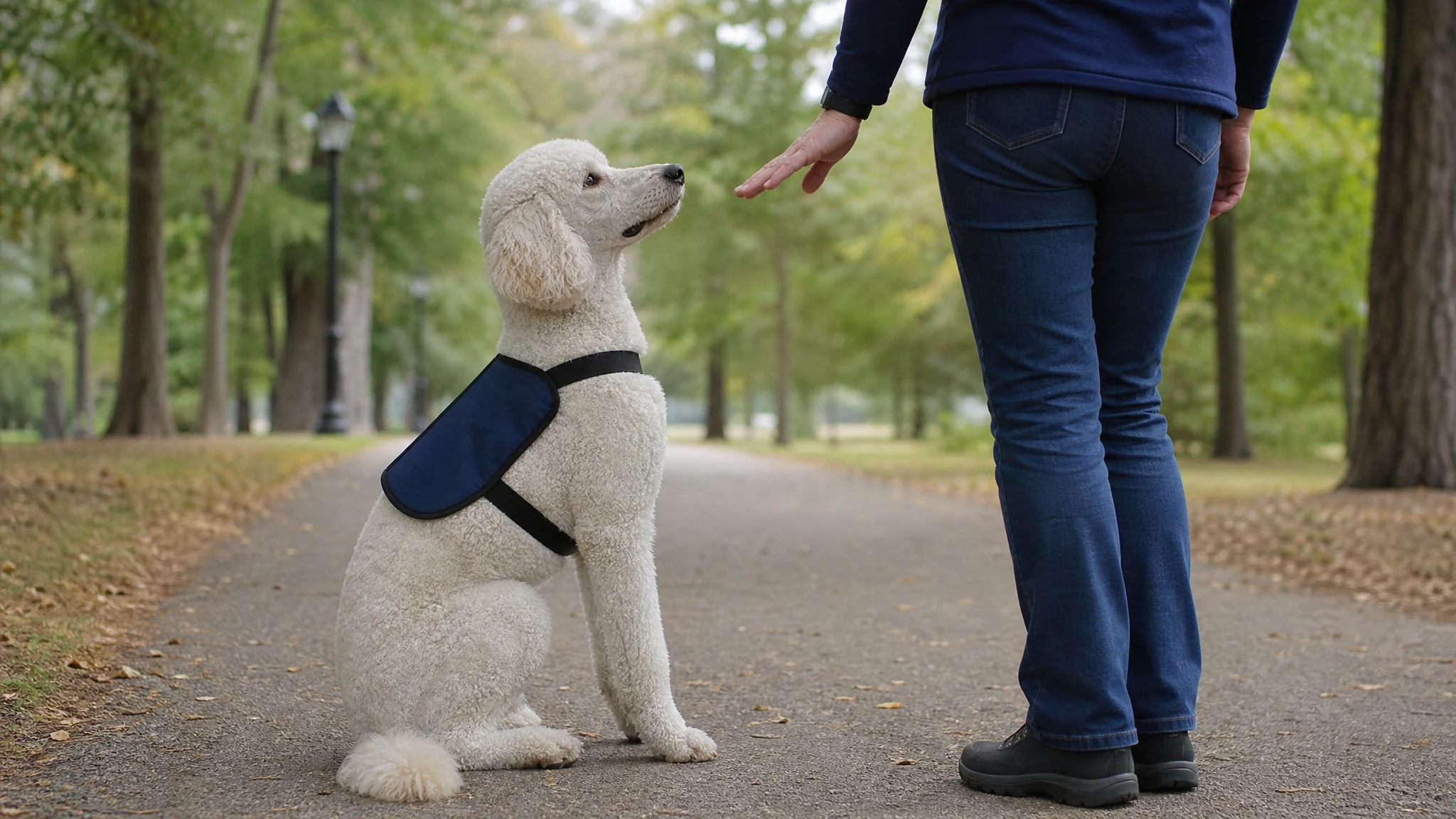
- Sit. Hold a treat just above the nose and move it back; reward when the rump lowers. Add the word once the movement is reliable.
- Down. From a sit, lower a treat to the floor between the paws; reward when the elbows touch down. Add the word after it works.
- Leave it. Show a treat in a closed hand; reward the dog for turning away from the hand. Move to leaving objects on the floor later.
- Heel. Reward the dog for walking at your side, on whichever side suits you, with the leash loose. Short stretches first.
- Settle. Reward the dog for lying down and relaxing on a mat. This one matters most in waiting rooms and under tables.
How Do Cues Differ From Tasks?
Examples of tasks in 28 CFR 36.104 and the ADA.gov service animals FAQ include retrieving items such as medicine or the telephone, assisting a person during a seizure, providing physical support for balance and stability, and alerting to allergens. Presence alone, for comfort or emotional support, is not a task.
Task cues depend on the person. A retrieve cue for a dropped item is a task cue for one handler and unnecessary for another. The tasks and public access test guide explains how tasks are chosen and described.
Which Cues Help in Public?
The ADA requires the dog to be harnessed, leashed or tethered in public unless those devices interfere with its work or the person's disability prevents it. Then the handler must control the dog by voice, signals or other effective means (28 CFR 36.302(c)(4), on eCFR).
As reasoning, a dog that responds to a cue from a distance, on a loose leash, is easier to control than one that needs correction. A dog that is out of control can be removed if the handler does not act, so reliable cues protect the handler's access.
Where Should You Teach Cues?
Start where the dog is calm, such as a quiet room, and add distraction one step at a time. This guide's rule of thumb is that a cue is not finished until the dog performs it in a new place. The proofing guide covers that step.
Owners who train their own dog can follow the owner-train guide for the larger sequence. If the dog is being trained for a psychiatric disability, a step-by-step guide to psychiatric service dog tasks can help plan the tasks that sit on top of these cues.
How Long Should a Practice Session Run?
This guide cannot source a figure, so it gives none. As a practical rule, end a session while the dog is still eager, and stop sooner if the dog loses interest or seems tired. Several short sessions in different places are easier on a dog than one long one.
Keep rewards small and keep the handler's mood light. A dog that learns cues are a game is easier to proof later. If you ever need to stop a session because the dog is unwell, call a veterinarian.
When Should a Veterinarian or Behavior Professional Get Involved?
If a dog suddenly stops answering cues it knew, or seems in pain, take it to a veterinarian first. A health problem can look like disobedience. If a dog shows aggression, the guidance is a veterinarian plus a certified behavior professional, not more cues.
A dog that cannot settle or ignore distractions after patient practice may not suit public work. That judgment belongs to a qualified professional, not this list.
What Words Should You Use?
Any consistent word works. The dog learns the sound, not the dictionary meaning. Pick words that are short and distinct from one another, and ensure everyone who handles the dog uses the same ones. Hand signals help in noisy places, and they matter if the handler cannot use their voice.
Questions
Does Alabama Require Specific Commands?
No. This guide found no Alabama or federal rule that lists commands. The law looks at whether the dog is individually trained to do work or tasks and is under the handler's control.
Is a Sit a Task?
Not by itself. The task must be work directly related to the person's disability (28 CFR 36.104).
Sources
- 28 CFR 36.302 on eCFR
- ADA.gov service animals FAQ, which also reproduces the 28 CFR 36.104 definition and task examples